In 1996, a full-page advertisement in a national broadsheet cost more than most small businesses spent on marketing in an entire year. The logic was simple. If a respected publication allowed your name alongside its journalism, readers transferred some of that trust to your brand. The medium was the message, and the message was credibility.
Three decades later, the principle has not changed. The format has. Today, sponsored content placements on established, niche-relevant websites serve the same function that premium print advertising once did. They position a brand within an editorial environment that audiences already trust. They provide context, relevance and a signal of quality that no amount of self-published content can replicate.
Yet the conversation around editorial placements has been muddied by years of low-quality practices, questionable vendors and a search industry that often confuses the tactic with the abuse of it. That confusion costs businesses real money. It costs them time. And it costs them opportunities to build the kind of brand authority that compounds over the years rather than evaporating with the next algorithm update.
This guide examines what sponsored content placements actually are, how they function as a modern brand-building tool, why Google's own frameworks support their legitimate use, and how to approach them with the strategic rigour they deserve. Whether you manage digital PR for a global brand or run outreach for a growing agency, the principles here will reshape how you think about editorial visibility.
What Are Sponsored Content Placements and Why Do They Matter Now
Sponsored content placements are paid editorial features published on established third-party websites. Unlike traditional display advertising, they take the form of articles, guides or features that sit within the host publication's content environment. The reader encounters them as editorial material, clearly disclosed as sponsored, within a context they already trust.
The distinction matters because trust is not transferable through banners. A display ad on a premium website borrows attention. A sponsored feature borrows authority. When a niche-relevant publication hosts a well-written article about your product, service or expertise, it functions as a digital endorsement. The publication is saying, implicitly, that your brand belongs in its editorial neighbourhood.
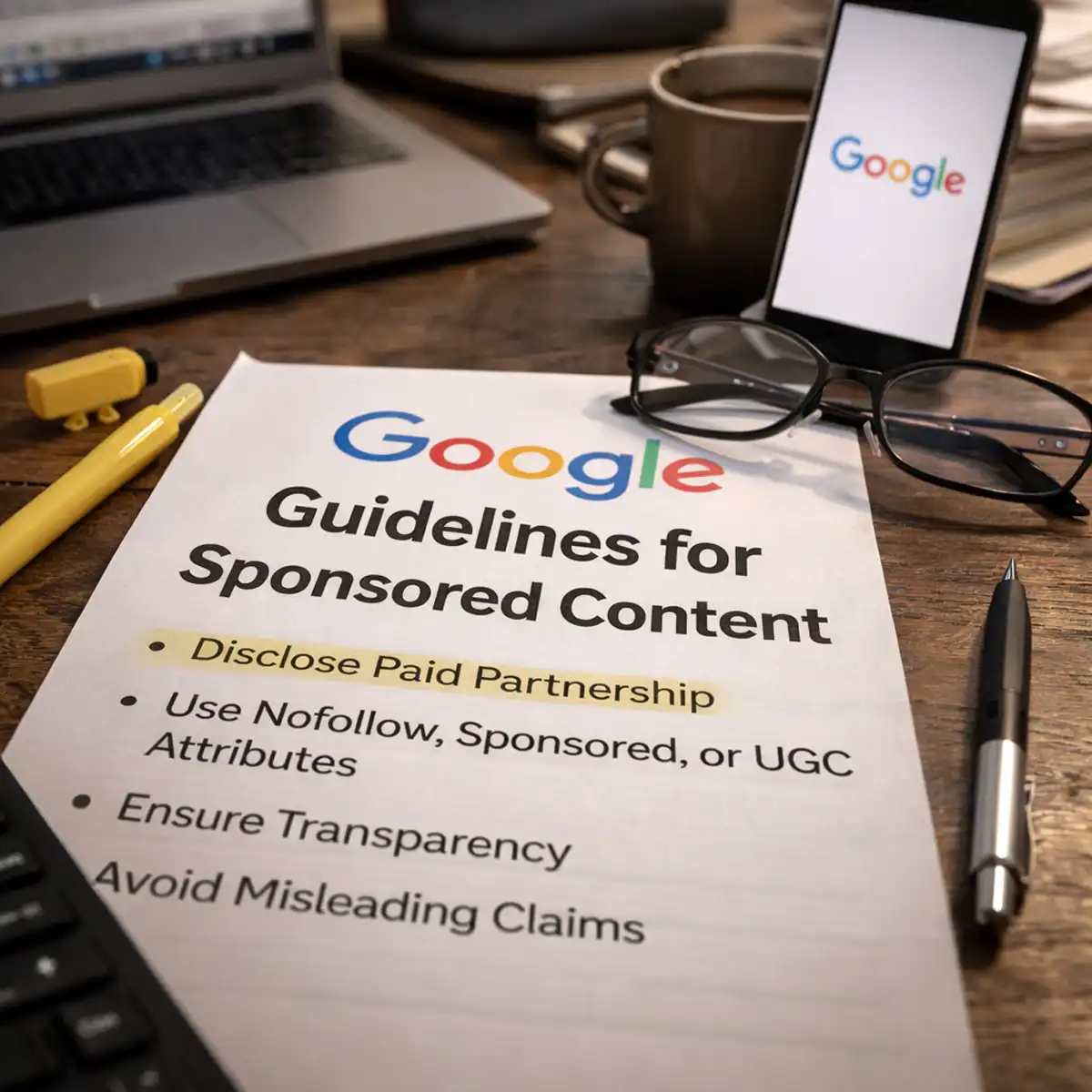
Google's own documentation acknowledges the existence and legitimacy of sponsored content. The rel="sponsored" link attribute, introduced in September 2019, was designed specifically to help search engines understand the relationship between paid placements and organic editorial content. Google did not create this attribute to penalise the practice. It was created to bring transparency to something that was already happening at scale across every industry.
The timing of this matters. As of early 2026, Google's Helpful Content System and successive core updates have made topical authority more important than ever. Websites that demonstrate genuine expertise, attract editorial references from relevant publications, and maintain a natural link profile consistently outperform those relying on technical manipulation alone. Sponsored content, executed properly, sits on the right side of this equation.
How Editorial Features Function as Modern Brand Endorsements
Think of the last time you read a feature in a publication you respect. You did not question whether the journalist had verified their sources. You did not check the domain's SSL certificate. You simply read, absorbed, and allowed the publication's reputation to vouch for the information. That is endorsement in its purest form.
Editorial placements work the same way for brands. When a company secures a content partnership with a publication that serves its target audience, it gains access to something money alone cannot manufacture: contextual credibility. The brand's message appears within an environment that the reader has already chosen to trust. The editorial framework does the heavy lifting.
Consider a jewellery brand featured on a specialist publication covering London's Hatton Garden district. The article does not need to shout about quality or craftsmanship. The publication's own reputation, its years of editorial coverage, its audience of informed buyers, does that work? The brand benefits from proximity to established authority. How niche relevance outperforms domain authority
This principle extends across every sector. A SaaS company featured on a respected marketing technology publication. A legal firm published on a regional business platform. A consultancy is placed within an industry-specific trade journal. In each case, the publication's editorial standards serve as a quality filter that audiences recognise instinctively.
The advertising industry understood this decades ago. Madison Avenue built empires on the principle that where your message appears matters as much as what it says. Sponsored editorial content is the digital evolution of that same insight, adapted for an era where audiences are more discerning, more fragmented, and more resistant to interruption than at any point in media history.
What Google's Quality Guidelines Actually Say About Paid Placements
Google's position on paid links and sponsored content is documented, specific, and frequently misrepresented. The search engine does not prohibit paid editorial placements. It requires transparency. The distinction is critical for any brand investing in editorial visibility.
Google Search Central's link spam documentation, updated throughout 2025, states that links within sponsored content should use the rel="sponsored" attribute. This tells Google's systems that the link exists within a commercial relationship. The documentation does not describe this as a penalty signal. It describes it as a classification mechanism.
John Mueller, Google's Search Advocate, has addressed this topic in multiple office hours sessions and public statements. His consistent position is that Google understands commercial relationships exist between publishers and brands. The concern is not the existence of paid placements but the failure to disclose them. Undisclosed paid links that attempt to manipulate PageRank are the target of SpamBrain, Google's AI-powered spam detection system. Properly disclosed sponsored content is not.
This matters enormously for the value proposition of editorial placements. A properly structured sponsored feature, published on a relevant website, with appropriate disclosure and the correct link attribute, operates entirely within Google's stated guidelines. The editorial value of the content, the relevance of the publication, and the transparency of the relationship are what determine quality.
Fun fact: The rel="sponsored" attribute was announced alongside rel="ugc" (user-generated content) in September 2019. Google gave webmasters 2 full years before treating these attributes as strong signals, one of the longest transition periods for any search classification change in the engine's history.
Why Niche Relevance Determines Placement Value More Than Raw Metrics
The sponsored content industry has been plagued by a fixation on metrics that do not measure what matters. Domain Authority, a proprietary score developed by Moz, and Domain Rating from Ahrefs are useful comparative tools. They are not Google ranking factors. Google does not use them. Google has never used them. Yet entire outreach strategies are built around chasing the highest number on a third-party scale.
What actually moves the needle is relevance. A placement on a niche publication with a Domain Rating of 35 that serves exactly your target audience will consistently outperform a placement on a generic high-authority site with a DR of 75 that has no topical connection to your business. Google's systems are designed to evaluate context. The topical relevance of the linking site, the semantic relationship between the content and your brand, and the editorial quality of the surrounding material all feed into how Google interprets the signal.
A 2024 analysis by Ahrefs examining over 14 million search results found that pages with backlinks from topically relevant sources showed stronger ranking correlations than those with links from high-authority but irrelevant domains. The study controlled for link volume, anchor text, and domain metrics. Relevance was the differentiating factor.
For brands considering sponsored content placements, this means the selection of publication matters more than any metric dashboard can capture. A London restaurant featured on a Mayfair lifestyle publication reaches exactly the audience it needs. A technology startup featured on a general news aggregator reaches everyone and no one. The quality of the editorial match determines the quality of the result.
How to Evaluate Whether a Sponsored Placement Will Deliver Lasting Value
Not all editorial placements are created equal. The difference between a placement that builds brand authority and one that wastes budget comes down to 5 evaluation criteria that every brand should apply before committing.
First, examine the publication's editorial standards. Does it publish original content regularly? Does it have identifiable authors, an about page, and a clear editorial focus? Publications that accept anything from anyone are not editorial platforms. They are directories wearing a disguise.
Second, assess audience alignment. The publication should serve the same audience your brand wants to reach. Check engagement signals: do articles receive comments, social shares, or references from other publications? A website with strong metrics but no visible audience interaction is a warning sign.
Third, evaluate the content quality of existing articles. Read 5 to 10 pieces. Are they well-written, informative, and genuinely useful? Or are they thin, keyword-stuffed pages designed to look like content without delivering substance? Your brand will be judged by the company it keeps.
Fourth, verify the site's technical health. Use Google Search Console or a tool such as Screaming Frog to check for indexation issues, broken links, and structural problems. A publication that cannot manage its own technical SEO is unlikely to deliver lasting value for yours.
Fifth, consider longevity. Will the content remain published and accessible for years? Some platforms archive or remove sponsored content after a fixed period. The best editorial placements are permanent features that continue building authority long after publication.
Where Sponsored Content Fits in a Broader Digital Marketing Strategy
Sponsored editorial placements are not a replacement for content marketing, technical SEO, or paid advertising. They are the connective tissue that makes all of those investments work harder. Think of them as the difference between a restaurant that relies entirely on walk-in traffic and one that also earns a mention in a respected food guide.
When a brand publishes high-quality content on its own website, that content needs external signals to be discovered. Google's crawl systems prioritise pages that receive links from already-indexed, trusted sources. An editorial placement on a relevant publication accelerates the indexation of your own content by providing exactly the kind of signal Google's systems are designed to follow.
At the same time, editorial placements generate referral traffic that paid search cannot replicate. A reader who discovers your brand through a trusted publication arrives with a fundamentally different mindset than one who clicks an ad. They arrive with borrowed trust. They are warmer leads, more engaged visitors, and more likely to convert because the publication has already done the qualification work.
The brands that understand this are the ones investing in content partnerships as a strategic pillar rather than a tactical afterthought. They budget for editorial placements alongside their search campaigns, their social strategies, and their content calendars. They measure results across referral traffic, brand search volume, ranking movement, and indexation speed rather than reducing the investment to a single metric.
What Brands Should Do Next to Build Authority Through Editorial Placements
The case for sponsored content placements is not new. It is as old as publishing itself. What has changed is the sophistication of the tools available to measure their impact, the clarity of Google's guidelines around their proper use, and the growing recognition among serious marketers that brand authority cannot be built in isolation.
Start by auditing your current editorial visibility. Where does your brand currently appear outside its own properties? If the answer is nowhere, that gap is costing you more than you realise. Identify 3 to 5 niche-relevant publications that serve your target audience. Evaluate their editorial quality, their audience engagement, and their willingness to work with brands on transparent, high-quality content partnerships.
Build a 12-month placement calendar. Prioritise relevance over volume. One well-placed feature on the right publication will outperform 10 placements on irrelevant sites by every measure that matters: traffic quality, brand perception, search visibility, and commercial impact.
In 1996, the magazine ad worked because readers trusted the publication that printed it. In 2026, the sponsored content placement works for exactly the same reason. The format evolved. The principle never did. The brands that recognise this and act on it with strategic discipline are the ones building authority that no algorithm update can take away.