Google’s Search Central documentation on link spam was updated in November 2025. The revision clarified several points about how the search engine evaluates sponsored links, paid placements, and commercial editorial relationships. Despite this, the SEO industry continues to circulate interpretations of these guidelines that range from incomplete to flatly incorrect. Some practitioners claim that any paid link results in a penalty. Others assert that the rel="sponsored" attribute renders a link valueless. Neither position is supported by Google’s actual documentation.
The consequences of misunderstanding these guidelines are real. Brands avoid legitimate editorial placement strategies because they believe Google prohibits them. Publishers implement link attributes incorrectly because they have read conflicting advice. Agencies make compliance promises to clients based on community consensus rather than documented policy. The result is an industry where fear of penalties drives more poor decisions than the penalties themselves.
This article examines what Google’s guidelines actually state, what Google representatives have said publicly, how the SpamBrain system evaluates link patterns, and what a compliant sponsored content practice looks like in 2026. Every claim is attributed to a specific source. Every distinction between confirmed policy and practitioner interpretation is clearly marked. The goal is clarity, not reassurance.
What Google’s Link Spam Documentation Actually States About Paid Links
Google’s Search Central documentation on link spam identifies "buying or selling links that pass PageRank" as a violation of Google’s spam policies. This is the sentence most frequently cited in debates about sponsored content. It is also the sentence most frequently taken out of context.
The same documentation provides a mechanism for legitimate commercial link relationships: the "sponsored" link attribute. This attribute was introduced in September 2019 alongside (user-generated content) as part of an update to how Google classifies link types. The documentation states that "sponsored" should be used to "mark links that are advertisements or paid placements." It describes this as a classification tool, not a penalty trigger.
The distinction is critical. Google does not prohibit commercial relationships between publishers and brands. It requires those relationships to be disclosed through appropriate link attributes. Undisclosed paid links that attempt to pass PageRank without attribution are what the policy targets. Properly attributed sponsored content with the correct link markup operates within the documented guidelines.
Google’s documentation was further updated in March 2025 to add clarity around " large-scale " link practices. The update specifically addresses patterns where hundreds or thousands of paid links are created across networks of sites with no editorial oversight. Individual, editorially produced sponsored features on legitimate publications are not described as a target of this policy. The language is directed at systematic, undisclosed manipulation at scale.
How Google Representatives Have Addressed Sponsored Content Publicly
Google’s public statements on sponsored content are more nuanced than the binary "paid links are bad" narrative suggests. John Mueller, Google’s Search Advocate, has addressed sponsored links in multiple Search Central office hours sessions and social media posts. His consistent position is that Google understands commercial content exists and that proper disclosure is the expectation.
In a January 2025 office hours session, Mueller stated that sponsored content with appropriate disclosure is "a normal part of the web" and that Google’s systems are designed to handle it. He distinguished this from undisclosed paid links, which he described as "trying to game the system." The framing is important: disclosure transforms a potentially problematic practice into a legitimate one.
Danny Sullivan, Google’s Search Liaison, has made similar points on X (formerly Twitter). In a March 2025 post responding to an industry question about sponsored editorial features, Sullivan noted that "sponsored content is advertising, and advertising funds much of the web. We have sponsored specifically for this." The statement implicitly acknowledges the legitimacy of the practice while reinforcing the disclosure requirement.
Gary Illyes, a Google Analyst, addressed the link attribute system at PubCon 2024 with a technical perspective. He confirmed that Google’s systems treat "sponsored" and "nofollow" as "hints" rather than directives. This means Google may choose to consider or ignore the signal based on its own evaluation of the link’s context. The practical implication is that Google retains flexibility in how it interprets attributed links, which is consistent with its broader approach to treating webmaster signals as guidance rather than commands.
How SpamBrain Evaluates Link Patterns and What It Targets
SpamBrain is Google’s AI-powered spam detection system. It was introduced in 2018 and has been updated continuously, with significant enhancements in the December 2024 and November 2025 spam updates. SpamBrain analyses link patterns across the web to identify manipulative practices. Understanding what it targets helps clarify what it does not target.
SpamBrain’s documented focus areas include large-scale link buying and selling networks, link exchange schemes, automated link creation through software or bots, and patterns of unnatural link velocity that suggest coordinated manipulation. The system analyses the link graph at scale, looking for structural patterns that indicate artificial relationships between domains.
What SpamBrain does not target, based on Google’s documentation and public statements, is individual editorial relationships between publishers and brands that are properly disclosed. A single sponsored feature on a niche publication, with the "sponsored" attribute correctly applied, does not match the patterns SpamBrain is trained to identify. The system is designed to catch systematic manipulation, not transparent commercial content.
This distinction is important for brands and publishers evaluating their compliance position. The risk from Google’s spam detection systems comes from undisclosed, large-scale, or deceptive practices. It does not come from individual, transparent, editorially produced sponsored features on legitimate websites. The two scenarios are fundamentally different in Google’s evaluation framework. the complete guide to sponsored content placements
Fun fact: Google’s SpamBrain processed and evaluated over 200 trillion URLs in 2025, according to Google’s annual webspam report published in April 2025. The system identified and took action against approximately 5 billion spam pages. For context, Google’s total known index contains roughly 400 billion pages, meaning SpamBrain flagged approximately 1.25% of all known web content.
What Compliant Sponsored Content Looks Like in Practice
Based on Google’s documentation and public statements, compliant sponsored content in 2026 has 5 clear characteristics. Each one is documented. None is ambiguous.
First, the content is published on a website with genuine editorial standards. The publication produces original content regularly, serves an identifiable audience, and maintains quality control over what appears on its pages. Google’s Helpful Content System evaluates site-level quality. A publication that maintains editorial integrity across its content portfolio provides a compliant environment for sponsored features.
Second, the sponsored nature of the content is disclosed to readers. Google’s documentation requires transparency. The specific form of disclosure varies by publication and jurisdiction, but the principle is consistent: readers should be able to identify that the content involves a commercial relationship.
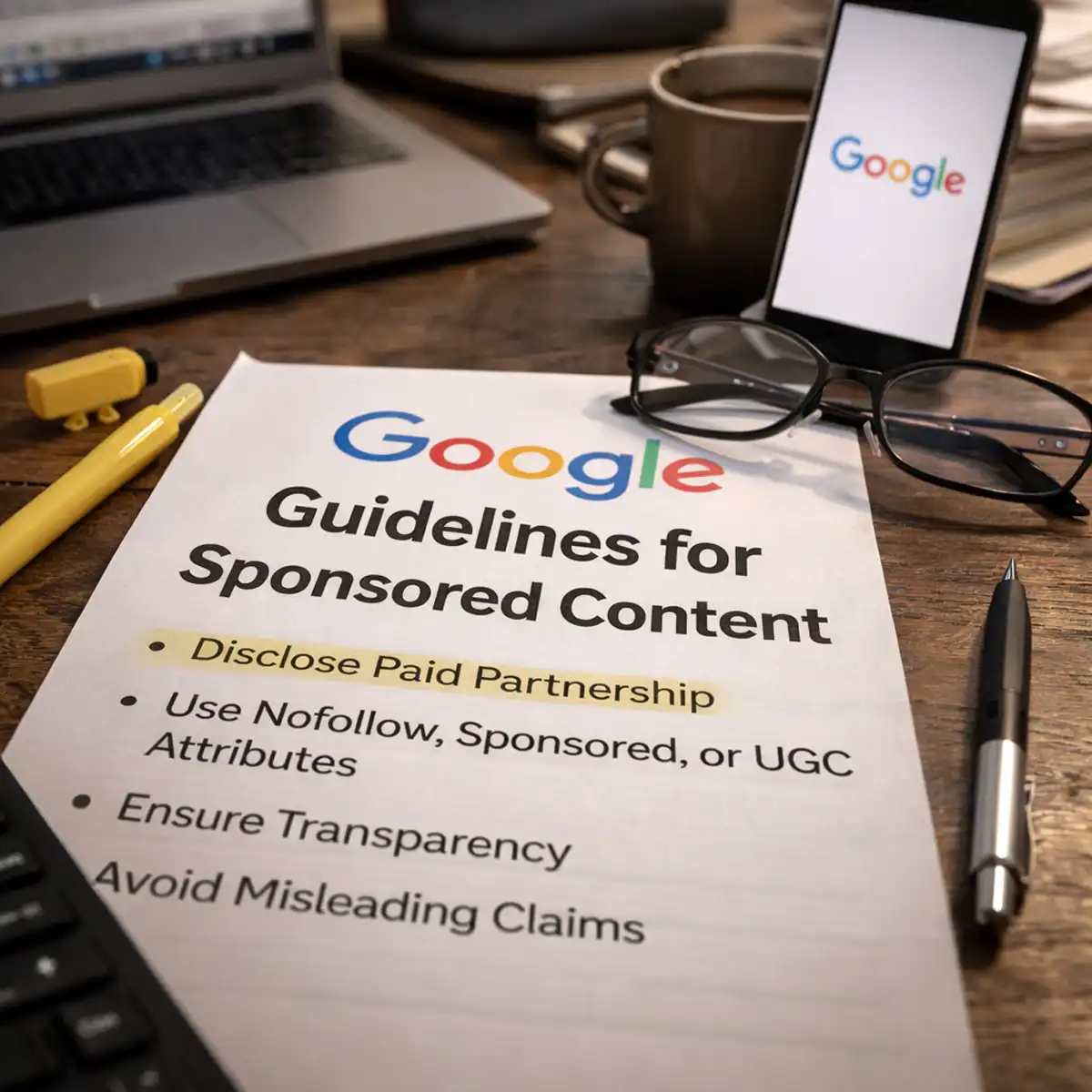
Third, links within the sponsored content use the "sponsored" or "nofollow" attribute. These attributes signal to Google that the link exists within a commercial context. Google’s documentation identifies these as the correct attributes for paid placements.
Fourth, the content provides genuine value to the publication’s audience. Google’s guidelines evaluate content quality independently of its commercial context. A well-researched, informative sponsored article that serves readers meets Google’s quality criteria regardless of how it was funded. How to write sponsored content that editors want to publish
Fifth, the placement is an individual editorial decision, not part of a large-scale, automated, or network-based link scheme. The difference between a brand securing a feature on a respected publication and a network distributing identical content across 500 sites is the difference between legitimate content marketing and the kind of practice SpamBrain is designed to catch.
Where the Industry Gets Compliance Wrong and What It Costs
The most common compliance error is using the wrong link attribute. It is avoiding editorial placements entirely based on a misreading of Google’s guidelines. Brands that interpret "Google penalises paid links" as "Google penalises all sponsored content" are making a category error that costs them genuine visibility and authority-building opportunities.
The second common error is overcompliance: using rel="nofollow" on every external link on a publication’s site, including genuinely editorial, unsponsored references. This practice sends inaccurate signals to Google about the nature of the site’s link relationships and can undermine the publication’s own link equity distribution.
The third error is undercompliance: running sponsored content without any link attribution and hoping Google does not notice. This is the scenario Google’s guidelines explicitly target. It carries real risk, particularly following SpamBrain’s enhanced link graph analysis in the November 2025 update. The risk is not hypothetical. Documented manual actions and algorithmic demotions have resulted from undisclosed paid link patterns.
The correct position is between these extremes. Use the rel="sponsored" attribute for paid placements. Disclose the commercial nature of the content. Maintain editorial quality. Operate within Google’s stated framework. This is neither complicated nor ambiguous. The documentation exists. The guidance is public. The path to compliance is clearly marked.
What the Evidence Supports and Where Uncertainty Remains
The evidence supports the following position: Google’s sponsored link guidelines distinguish between undisclosed, manipulative paid links and transparent, editorially produced sponsored content. The former is a documented spam policy violation. The latter, when properly attributed, is described by Google’s own documentation and representatives as a normal part of the web.
Where uncertainty remains is in Google’s treatment of rel="sponsored" as a "hint" rather than a directive. Google retains discretion in how it evaluates attributed links. The practical effect of this discretion on individual placements is not publicly documented and may vary by context. Practitioners should acknowledge this uncertainty rather than claiming certainty in either direction.
What is not uncertain is the direction of Google’s policy. Transparency is rewarded. Deception is penalised. Legitimate commercial relationships are expected and accommodated within Google’s link classification framework. Brands and publishers who operate within this framework have the strongest compliance position available. Those operating outside it carry a risk that increases with every spam update. Red flags that reveal low-quality placement opportunities